
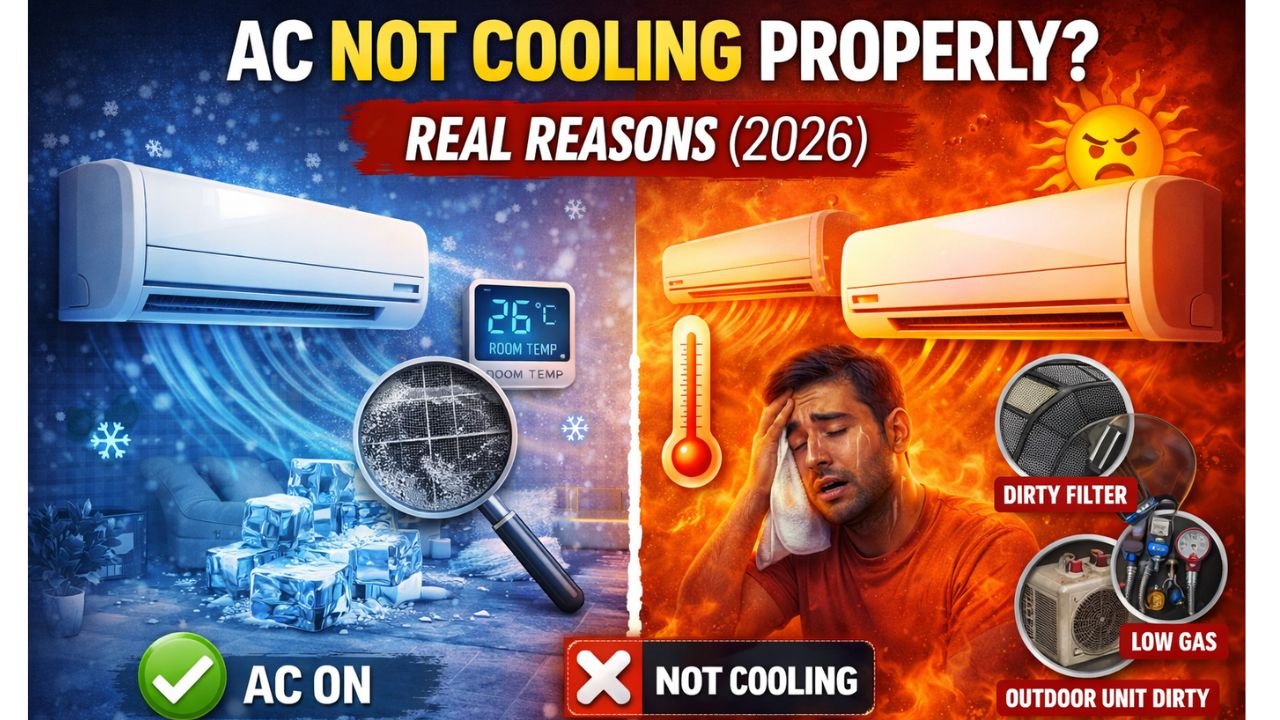
If your AC is not cooling properly, the problem is not always with the AC itself. In real usage, cooling performance depends on factors like room size, heat buildup, airflow, and how the AC is being used. A 1.5 ton AC may work perfectly in one room but struggle in another because of these conditions. This is why cooling often feels inconsistent even when the AC is running continuously.
You switch on your AC expecting quick relief.
For a few minutes, everything feels fine.
Cool air starts flowing, and the room begins to settle.
Then slowly, something changes.
The cooling doesn’t feel strong anymore.
The room feels warmer than it should.
And the first thought that comes is simple:
👉 “AC is not cooling properly”
It Starts Normal… Then Something Feels Wrong
When you turn ON your AC, the cooling feels fine at first.
After a while, the room stops feeling as comfortable as expected.
- initial cooling happens, but it doesn’t sustain for long
- the AC keeps running, yet the room doesn’t feel cool enough
The Problem Is Not Always the AC
The first assumption is usually that the AC has a fault.
But in many cases, the machine is working correctly under load.
- gas or servicing is not always the real issue
- external conditions often affect cooling more than the AC
Notice These Signs Carefully
Cooling problems usually follow a pattern you can observe.
These signs indicate the issue is related to conditions, not failure.
- the room cools quickly but loses that cooling soon
- cooling feels weaker during daytime compared to night
- AC runs longer but comfort still feels incomplete
Room Size Plays a Bigger Role Than You Think
1.5 Ton AC performance depends heavily on how well it matches the room.
Even a good AC struggles when the room demand is higher.
- ideal room size allows faster and stable cooling
- larger rooms increase cooling time and continuous load
👉 When Room Size Is Ideal
In a balanced space, the AC reaches the set temperature smoothly.
Once stabilized, it reduces effort and maintains comfort easily.
In a room around 120–150 sq. ft. with normal conditions:
- cooling feels even and consistent across the room
- AC does not need to run aggressively all the time
👉 When Room Is Slightly Larger
The AC can still cool the space, but it takes more time.
Heat conditions inside the room start affecting performance.
In slightly larger rooms (150–180 sq. ft.):
- cooling feels slower compared to ideal rooms
- AC runs longer to maintain the desired temperature
👉 When Room Is Too Large
Once the room exceeds the AC capacity, performance drops.
The AC keeps working but cannot reach stable cooling.
Once you go beyond 180–200 sq. ft :
- cooling feels weak even after long usage
- the AC rarely gets time to stabilize
👉 When Conditions Increase Room Load
Even a small room can behave like a large one.
Heat entering the room increases the cooling demand.
- direct sunlight raises room temperature continuously
- airflow gaps and heat sources add extra load
Check This👉 Best 1.5 Ton AC Buying Guide (2026)
Cooling Load vs AC Capacity
Every AC is built to handle a certain level of heat.
When the load increases beyond that, cooling efficiency drops.
- larger rooms and heat sources increase cooling demand
- higher demand forces the AC to work continuously
👉 when load exceeds capacity, cooling will always feel weak
Heat Returning Is the Real Problem
An AC doesn’t just cool once — it maintains temperature.
If heat keeps entering, the AC cannot stabilize.
- continuous heat forces repeated cooling cycles
- cooling feels inconsistent and incomplete
Usage Habits Also Affect Cooling
How you use the AC can increase or reduce its efficiency.
Small mistakes can create unnecessary load.
- very low temperature settings increase continuous running
- frequent ON/OFF interrupts proper cooling cycles
Expectation vs Reality
Most users expect fast and constant cooling.
But actual performance depends on stable room conditions.
- lower temperature does not mean faster comfort
- continuous running does not guarantee better cooling
The Hidden Cooling Cycle
Cooling issues often follow a repeating pattern.
This cycle creates the feeling that AC is not working properly.
- room cools initially and then slowly gains heat
- AC works again before reaching stable condition
Explore👉 1.5 Ton AC Power Consumption
Simple Way to Understand the Issue
Instead of checking the AC, ask this:
👉 “Does my room stay cool after 10–15 minutes?”
✔ If YES → AC is fine
❌ If NO → room conditions are the issue
What Actually Improves Cooling
Better cooling comes from reducing the load on the AC.
When the AC stabilizes, performance improves naturally.
- control sunlight and reduce heat entry
- maintain balanced temperature settings
👉 When the load reduces, cooling improves naturally
Final Insight
👉 AC performance is not just about tonnage
👉 It’s about how much heat your room is fighting against
Check This👉 How to Choose the Right 1.5 Ton AC
FAQ
Why does my AC feel effective only for a short time?
Cooling feels strong initially because the room temperature drops quickly at the start. After that, if heat keeps entering the room, the AC shifts from cooling to maintaining, which feels less powerful. This change is often misunderstood as poor performance.
How do I know if my AC is actually underperforming?
If your AC runs continuously for long periods without reaching a comfortable level, it may not be stabilizing properly. This usually indicates high cooling load rather than a direct fault in the AC.
Can a “perfectly working AC” still feel weak?
Yes. Even when the AC is functioning correctly, it can feel weak if the room conditions increase the cooling demand. Factors like room size, sunlight, and airflow can reduce the perceived cooling performance.
Is setting a lower temperature the right way to improve cooling?
Lowering the temperature does not improve cooling speed significantly. It increases the workload on the AC, which can lead to continuous operation without improving comfort.
Can room conditions really impact cooling this much?
Yes. Room behavior plays a major role in cooling performance. A room that retains cooling allows the AC to work efficiently, while a room that gains heat continuously forces the AC to keep working.
Verdict
If your AC is not cooling properly, the issue is usually not just the AC itself. In most cases, room size, heat conditions, and usage patterns create continuous load, preventing the AC from stabilizing. Once these factors are managed, cooling improves naturally without unnecessary servicing or upgrades.
Related Guide
🔎 Best 1.5 Ton 5 Star AC in India (2026)
🔎 Best 1.5 Ton 3 Star AC in India (2026)